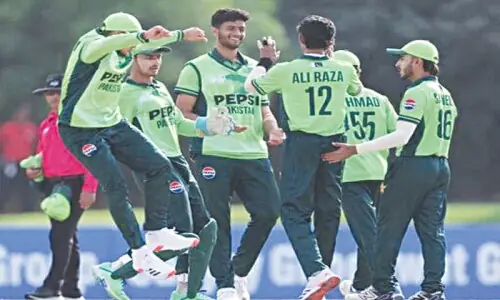
It had Champions Trophy 2017 written all over it, as Ahmed Hussain bucketed a skier at point to dismiss India’s Deepesh Divendran and seal Pakistan’s maiden U-19 Asia Cup title.
Just like that fateful day at the Oval in London, an opener fired with all guns blazing and the pace spearhead routed the Indian top order. The script was nearly the same, the personnel different — apart from one man. Sarfraz Ahmed.
Eight years after leading a youthful Pakistan side to Champions Trophy glory, Sarfraz once again found himself at the heart of a defining Pakistan-India moment. This time, he wasn’t wearing pads or gloves. Instead, he stood on the sidelines, mentoring a group of teenagers as they rose to become Asia’s Under-19 kings.
Interestingly, the last time Pakistan won an U-19 title — without sharing the trophy — was back in 2006. That side, too, was captained by Sarfraz. So, when the celebrations officially commenced, Sarfraz’s legacy was impossible to ignore. Ecstatic fans, former cricketers, media experts, and administrators alike were united in praise. The Champions Trophy-winning captain was receiving applause from all directions. It was, unquestionably, Sarfraz’s moment to bask in glory.
Pakistan’s U-19 cricket team were recently
crowned kings after comprehensively beating
India in the final of the Under-19 Asia Cup.
This is the story of how a former captain chose
process, patience and conviction to make
this team
But the bunch of boys who brought him that praise had been nurtured long before he arrived — raised quietly, methodically and patiently, when no one was watching them. Not even Sarfraz himself. That work was carried out by another former Pakistan skipper — less celebrated perhaps, but no less significant in stature.
In November 2024, Azhar Ali was offered a seat on Pakistan’s national selection committee.
For many former captains, it would have been a logical step — authority, influence and visibility at the highest level. Azhar turned it down.
“I was offered a place on the selection committee, but I declined because my interest has always been more towards development,” Azhar tells Eos. “Even during my playing days, I consistently felt that, if you really want to make a difference, it has to be at the development and age-group level.”
It was a decision driven not by ambition but by conviction. The Pakistan Cricket Board (PCB) — particularly Aaqib Javed, the man behind most sporting decisions in Pakistan cricket today — sat down with Azhar. Together, they devised a roadmap for reviving the U-19 structure.
But instability within the PCB meant the challenge began almost immediately. The U-19 inter-district three-day tournament, a key pillar in identifying red-ball talent, was cancelled two months earlier. Azhar was suddenly deprived of the most reliable performance data available.
A conventional approach was no longer possible.
“We asked coaches working with the districts who were the best players in their view,” Azhar explains. “We took trials, made four teams, and then shortlisted 30 players to work with.”
From that improvised yet inclusive process emerged a preliminary squad that featured in the U-19 T20 Asia Cup later that year. Pakistan reached the semi-finals, beating India in the group stage before losing to a strong Bangladesh side.
For Azhar, the results were secondary. What mattered more was how the players responded.
“The process started much earlier than people realise,” he says. “At this level, players are still in a development phase — technically, tactically, mentally and fitness-wise. That’s why extra work is always required.”
Encouraged by early signs, Azhar and his coaching staff doubled down on preparation. A series of skills’ development camps followed. Seventy of the country’s top youth players were invited to participate in national U-17 and U-19 one-day tournaments. From there, 26 players were shortlisted for an intensive two-month camp in Multan — recently designated as the central training hub for Pakistan’s U-19 sides.
The camp, which began on October 23, 2024, would ultimately decide Pakistan’s squads for both the U-19 Asia Cup and the U-19 World Cup.
“Our first priority was to identify the best talent and then address every requirement through camps,” Azhar explains. “Fitness, fielding, strong basics — so that, under pressure, these things translate into positive results.”
But development, Azhar believed, could not be limited to cricketing skills alone. “We worked on sports psychology and created safe environments, where players could talk about anxiety, fear, and how to overcome them,” he says. “Mental strength at this age is just as important as skill.”
Discipline and lifestyle were treated as non-negotiables. “Discipline was important not only on the field but also off the field,” Azhar adds. “We worked on communication, English classes, media handling — how to represent Pakistan properly. Being a good ambassador is part of being an international cricketer.”
Crucially, Azhar resisted the temptation to over-coach. “We worked on batting and bowling skills, but we were careful not to overdo it,” he says. “The idea was to improve players without compromising their natural talent.”
Style, he insisted, would always come after substance. “For me, performance comes first. No style matters unless it produces consistent performance,” Azhar says. “Some players are aggressive, some conventional, some tentative — every style has value if there is balance.”
Before the camp concluded, Azhar abruptly stepped away from the role — a development never formally announced by the PCB. Quietly, Sarfraz Ahmed was handed the responsibility of overseeing the youth sides.
Azhar had set the stage. Sarfraz was now tasked with delivering the final act. “Obviously, when you put in so much effort and then step away, there is disappointment,” Azhar admits.
“But Sarfraz is a very good choice, and he’s like a brother to me. If he’s doing well, that’s what matters.” The disappointment was personal, but never bitter.
The team Azhar helped shape went on to win every match of the U-19 Asia Cup except one — a group-stage loss to India. In the final, they turned the tables emphatically, thrashing their arch-rivals by 191 runs.
Opener Sameer Minhas batted with authority. Pacer Ali Raza tore through the Indian batting line-up. And when the final catch was taken, Pakistan’s next generation announced itself in style.
While Sarfraz took centre stage during the celebrations, Azhar watched from the background — content, reflective, and quietly fulfilled. “I was genuinely happy,” he says. “This was complete teamwork. No individual can take credit. Everyone stayed within their domain and gave their best.”
For Azhar, the Asia Cup triumph is not a destination — merely a checkpoint. “The biggest difference can be made at the age-group level,” he says. “At higher levels, you can only make minor changes. The next generation of Pakistan cricket comes from these age groups.”
It’s a philosophy shaped by his own journey. “I came through this same kind of system myself,” Azhar reflects. “This culture of raising youngsters the right way — that’s what helped me grow.”
With the U-19 World Cup set to begin on January 15, Pakistan’s young champions now carry both momentum and expectation. How they perform on the global stage will say much about the value of investing in recently retired players — not as selectors or commentators, but as builders of the future.
And whether the spotlight falls on Sarfraz or not, the foundation beneath this team tells a deeper story — one of patience, process, and a former captain who chose the harder, quieter path, so Pakistan cricket could dream again.