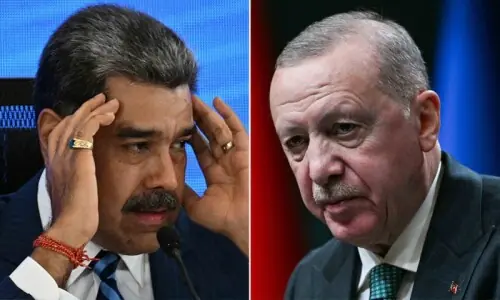
ISTANBUL: Turkiye’s President Recep Tayyip Erdogan spoke by phone on Saturday with his Venezuelan counterpart Nicolas Maduro, urging him to keep “dialogue open” with Washington amid mounting fears of US military action.
Washington has been ramping up the pressure on Caracas with a major naval build-up in the Caribbean, conducting more than 20 strikes targeting boats allegedly involved in drug-trafficking that have caused at least 87 deaths.
Washington has so far not provided any evidence showing their connection to the alleged trafficking.
“It is important to keep channels of dialogue open between the US and Venezuela,” Erdogan told him, according to a statement from his office on X, expressing hope that “the tension will ease as soon as possible”.
Erdogan said that Turkiye was closely following the developments in the region and believed that “problems can be solved through dialogue”.
Latin American country swears in 5,600 new
troops amid US military build-up
Venezuela’s foreign ministry said that the Turkish leader had expressed “deep concern over the threats facing Venezuela, particularly the military deployment and various actions aimed at disrupting peace and security in the Caribbean.” Maduro “explained in detail the illegal, disproportionate, unnecessary, and even extravagant nature of these threats,” a ministry statement said.
The pair also discussed the mass suspension of international flights after US President Donald Trump’s declaration last month that Venezuelan airspace should be considered “closed”.
Maduro said on Wednesday that he had had a “cordial” phone call with Trump 10 days earlier, during the US military build-up in the region.
Trump had confirmed the telephone conversation with Maduro without providing any details.
Earlier this week, Trump summoned his top national security officials to discuss Venezuela after months of tensions with Caracas.
The US leader has accused Maduro of leading a drug cartel, a claim Venezuela denies. Last month, Washington sent the world’s largest aircraft carrier to the Caribbean, along with a fleet of warships.
Turkiye has strong ties with Venezuela, with Erdogan last visiting the country in December 2018 to offer support to Maduro after Washington and several European nations disavowed the Venezuelan leader’s re-election over accusations of fraud.
Various US officials and media reports have suggested that if Maduro were forced out, he could seek refuge in Turkiye.
“I hear Turkiye and Iran are lovely this time of year,” Republican Senator Lindsey Graham wrote on X last week in a suggestion that the Venezuelan leader should flee.
Troops build-up
The Venezuelan army swore in 5,600 new soldiers on Saturday, as the United States cranks up military pressure on the oil-producing country.
President Nicolas Maduro has called for stepped-up military recruitment as the United States deployed a fleet of warships and the world’s largest aircraft carrier to the Caribbean under the pretext of combating drug trafficking.
American forces have carried out deadly strikes on at least 22 vessels, killing at least 83.
Maduro asserts the American deployment aims to overthrow him and seize the country’s oil reserves.
“Under no circumstances will we allow an invasion by an imperialist force,” Colonel Gabriel Alejandro Rendon Vilchez said during the ceremony at Fuerte Tiuna, Venezuela’s largest military complex, in Caracas.
According to official figures, Venezuela has 200,000 troops and an additional 200,000 police officers.
Also Saturday, a former opposition governor died in prison where he had detained on charges of terrorism and incitement, a rights group said.
Alfredo Diaz was at least the sixth opposition member to die in prison since November 2024.
They had been arrested following protests sparked by last July’s disputed election, when Maduro claimed a third term despite accusations of fraud.
Diaz, governor of Nueva Esparta from 2017 to 2021, “had been imprisoned and held in isolation for a year; only one visit from his daughter was allowed,” said Alfredo Romero, director of the NGO Foro Penal, which defends political prisoners.
The group says there are at least 887 political prisoners in Venezuela.