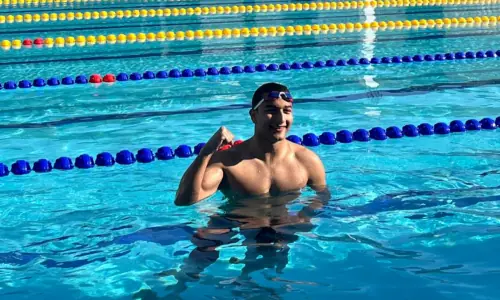
It takes a village to raise a child, and, in the case of Hamza Asif, it took a village to raise a national record holder.
The “village” in question is Faisalabad, where Hamza is already something of a local celebrity. Most of Pakistan’s top swimmers were produced by Karachi, Lahore and Islamabad, and then international quarters far and wide. Hamza’s roots came to the forefront when his triumph in the 50m freestyle in 2023 earned him the nickname of “The Rocket” since the event denotes the fastest aquatic Pakistani.
It was in Faisalabad where he was shuttled to and from 5am swim practices by his grandparents, nurtured by Imran Nazir at the Chenab Club. When he began swimming at the age of six, it was his mother who would pace the edge of the pool teaching him the basics of the sport, much to the disapproval of conservative men who were uncomfortable by her presence. It did not faze her.
The country’s textile hub does not have a 50m pool, whose single lap he completed in historic fashion on Wednesday afternoon to set a new national record in the men’s 50m breaststroke.
He became the first Pakistani ever to swim the event under 30 seconds as he clocked 29.99.
If you froze the moment in time and examined it, you could see exactly where and how this monumental feat materialised. His mother bent down in prostration immediately after to offer thanks for her son’s victory. She has devoutly prayed for him always, “but Hamza has the prayers of so many people,” she told Dawn after his triumph.
Well before the well-wishes drenched the happy parents and sister at the KMC Swimming Pool, snide parents offered a cold shoulder when Hamza’s mother reached out for contact information of a coach for him when he was younger. “He’s from Faisalabad” was said with snarky undercurrents.
His younger sister and mother ping-ponged the exact defining moments in his career so far.
“He wrote in a school essay once that he wanted to be Pakistan’s fastest swimmer,” the proud mother said with teary eyes.
“I had to convince my parents to let me come to Karachi to watch Hamza bhai’s race!” his sister chuckled. She even wrote about his early sporting victories for a magazine once.
It was as though the universe had convinced the family that Hamza was on the cusp of sporting excellence, and everyone must be there to witness it. Both sets of maternal and paternal grandparents were immediately video called to be given the good news and digitally bring them into the moment. The tech-savvy grandparents are also swimming-savvy, understanding the technicalities of the sport and following Hamza every step of the way.
Hamza’s mother credited her super sports star father with being Hamza’s inspiration for continuously pushing the boundaries of greatness.
He pushed the boundaries and knocked on the door of Bard Foundation, a non-profit dedicated to financially supporting athletes throughout their journey with strict selection criteria. While the organisation typically has focused on squash and tennis players and mountaineers, it took a chance on the aquatic species and welcomed Hamza to the family.
“Thank you for trusting me,” 19-year-old Hamza said to Mehreen Dawood when he finally emerged in the audience stands to thunderous applause and “shabbash shabbash!” from teammates. He melted into the arms of his mother when he finally met her and his father, then going straight to childhood coach Imran for another bearhug.
Mehreen, member of the board of governors of the foundation, was largely speechless when asked how she felt about taking a chance on him.
“Ecstatic,” she told Dawn before adding that Hamza was a wonderful person overall. His meticulous attention to detail while training, the way he conducted himself, the way he straddled the line between humility and confidence was what convinced Mehreen that he was a semi-cut diamond in need of the highest-grade polishing.
The Bard Foundation’s support sent Hamza to Thailand for training, which he credited as being foundational to his initial improvement, which later opened the doors of University of Tennessee, Southern as the university offered him a scholarship to study and swim with them.
“My coach has worked hard on me in these past few months,” Hamza told Dawn after the day concluded.
“We’ve been training for this very event, and I was expecting the record,” he said with quiet confidence.
Mehreen, the Bard Foundation and Activit were the latest to join Hamza’s village of support, all of whom Hamza expressed gratitude to.
“Behind my journey are my parents, and I cannot thank them enough,” the teenager said, his words loaded with a love you can tell he’s carried all his life. He looked something like a powerful Greek god with his curly hair and the afternoon sun shining down on him like a spotlight for his unthinkable moment.
“Special thanks to my team, my coach, and everyone who believed in me, and thank you so much everyone.” Hamza’s gratitude to his university was equally magnanimous as their adoration of him.
“We are so proud of Hamza and proud to call him a FireHawk,” the varsity wrote for him on social media after he claimed gold in the 100m freestyle on Tuesday.
In an earlier post this summer on Hamza’s arrival in the fall class, the varsity said he will “make an immediate impact to our men’s team, and will primarily swim sprint [freestyle] for the FireHawks”.
And yet, his first individual national record was in the breaststroke sprint. He lived up to the university’s hype and immediately stormed to gold in the men’s 50m freestyle just minutes later in 23.66, a full second faster than the second place finisher. He had single-handedly won all of Wapda’s gold medals thus far.
“I’m aiming for more records in the future, this event
was a benchmark for me.
“This is just the start — I’m coming for more,” he grinned with authoritative confidence and faith in himself.
Just as Mehreen had put his faith in him, Hamza had put his faith in Allah, first and foremost.
“We do the best we can, and the rest, we leave to Him,” his father said as he pointed a finger and looked up to the sky.